You published the post. You added the affiliate links. You hit publish and moved on.
That's what most affiliate bloggers do. And it works — until it doesn't.
Here's the uncomfortable truth: affiliate links break all the time, quietly, while you're busy writing your next post. No alarm goes off. Your site looks fine. But somewhere in your content, a link is sending readers to a 404 page instead of a product page. And every click on that link is a commission you'll never see.
This post explains exactly why it happens, how often, and what you can do about it.
Why Affiliate Links Break
Unlike a regular link to a blog post or news article, affiliate links are fragile by design. They depend on a chain of moving parts — your link, the affiliate network's tracking system, and the merchant's website — all working together perfectly. When any part of that chain changes, the link breaks.
Here are the most common reasons it happens.
The merchant switches affiliate platforms
This is the most common cause, and the most painful. When a company moves from one affiliate network to another — say, from ShareASale to Impact — every tracking URL they previously issued becomes invalid overnight. Your old links still look fine in your content. They just stop working.
Research suggests that around 5% of affiliate tracking implementations change every single month. If you have links across 20 different programs, statistically at least one of them is quietly breaking right now.
The product goes out of stock or gets discontinued
This is especially common for Amazon affiliates. A product you reviewed six months ago might be delisted, out of stock, or replaced with a newer model. Your link still points to the old product page — which now shows an error or redirects to a completely unrelated item.
The merchant restructures their website
Companies redesign their sites. They change URL structures, move pages around, or rebuild entire sections. When that happens, your old deep links — the ones pointing directly to a specific product or landing page — often stop working, even if the product itself still exists.
Simple typos and encoding errors
Sometimes a link was never quite right to begin with. A misplaced character, a broken redirect, or a tracking parameter that got stripped during copy-paste. These are easy to miss when you're publishing quickly.
How Often Does This Actually Happen?
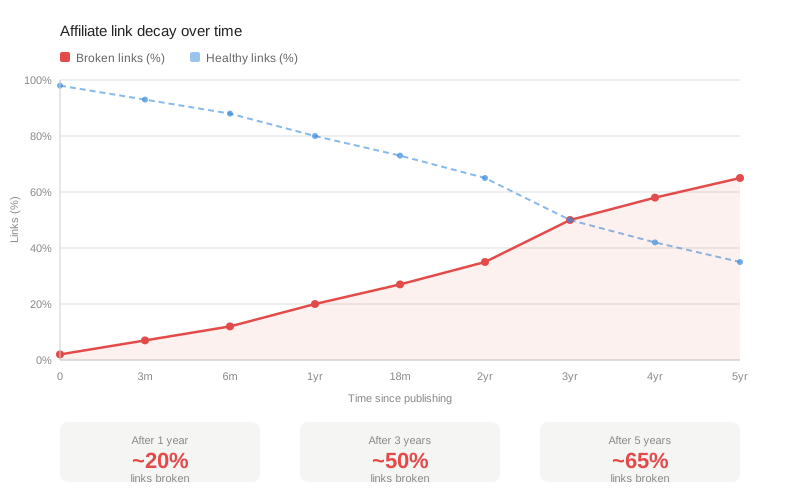
More than most bloggers realize. Nearly all internet pages suffer from link rot over time — after 20 years, 98.4% of all web links become broken. That's an extreme timeframe, but the decay starts much earlier.
Think about your own content. If you've been publishing for two or three years, your oldest posts are packed with affiliate links you haven't checked since the day you published them. Programs change. Products disappear. Merchants rebuild their sites.
Without systematic monitoring, up to 20% of affiliate links on a site could be broken without the owner ever knowing. For a blog with 200 affiliate links, that's 40 broken links silently bleeding commissions.
Why Most Bloggers Never Find Out
The insidious part is that nothing looks wrong on the surface. Your post is live. The link is there. Readers can click it. But instead of landing on a product page, they hit a dead end — and they don't tell you. They just leave.
When an affiliate link breaks, your content keeps running and clicks keep coming in. The only thing that stops is commissions. Without monitoring, you'd only notice if you happened to manually click every link across every post you've ever published. Nobody does that.
What You Can Do About It
The fix isn't complicated, but it does need to be systematic.
Manual checks work for small sites with fewer than 20 or 30 links. Set a reminder to click through your most important links once a month. It's tedious, but it's better than nothing.
Free tools like Google Search Console can flag some broken links, but they're not built specifically for affiliate links and miss a lot of edge cases — particularly redirects that technically "work" but no longer carry your affiliate tracking parameters.
Dedicated monitoring tools like Brokenly are built specifically for this problem. You add your sitemap, and Brokenly automatically finds every affiliate link across your entire site, checks them on a regular schedule, and alerts you the moment one breaks — before you've lost a week's worth of commissions.
The Bottom Line
Affiliate links break. It's not a question of if, it's when. The bloggers who protect their income are the ones who have a system in place to catch it early — not the ones who discover a broken link three months later while auditing a post.
If you've never checked your affiliate links, now is a good time to start.
Try Brokenly free for 14 days — no manual checking required, no credit card needed. See exactly what's happening with your affiliate links right now.